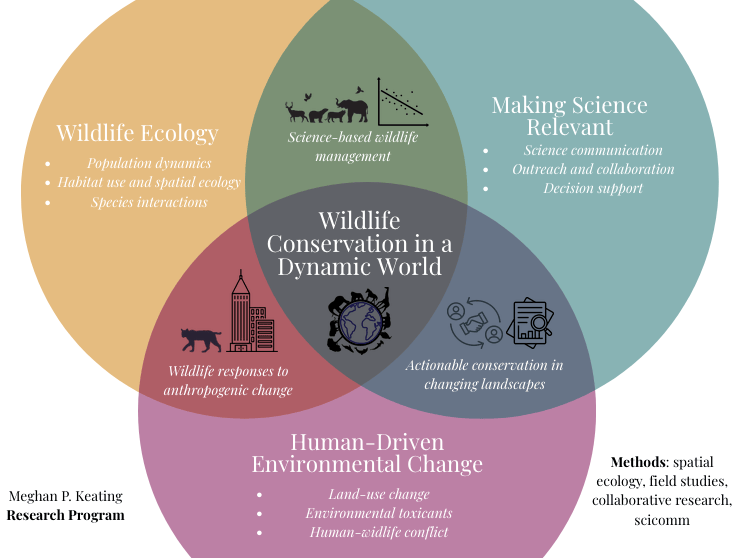
I study how human-driven environmental change reshapes ecological systems—and what those changes mean for wildlife conservation and management. My work is grounded in the idea that understanding ecological mechanisms can lead to better conservation decisions. I approach research collaboratively, with an emphasis on producing science that is both actionable and responsive to real-world conservation needs.
Wildlife Ecology
Our ability to conserve and manage wildlife depends on understanding their ecology. I study the ecological roles of wildlife and how they use space, with a particular interest in carnivores and their interactions with other species.
Relevant Studies
Peterson, SH, JT Ackerman, BL Fettig, AC Greenawalt, CA Hartman, MP Keating, & MP Herzog (2026). Wetland characteristics influence dabbling duckling habitat use and movement. Ornithological Applications duag14.
Keating, MP, TR Rainwater, R Singh, M Priore, SG Platt, PM Wilkinson, T Levi, CM Bodinof Jachowski, & DS Jachowski (2025). Bobcat predation on american alligators in coastal South Carolina. Southeastern Naturalist 24:N28–N37.
Nettles, JM, C Abramowitz, WW Boone, SN Harris, CE Horton, MP Keating, DL Nelson, SN Smith, K Steen, EK Buchholtz, & DS Jachowski (2025). American black bears (Ursus americanus) as an apex predator: Investigating the ecological role of the world’s most abundant large carnivore. Mammal Review 56:e70014.
Peterson, SH, JT Ackerman, MP Keating, CH Schacter, CA Hartman, ML Casazza, & MP Herzog (2022). Predator movements in relation to habitat features reveal vulnerability of duck nests to predation. Ecology and Evolution 12:e9329.
Wildlife in a Changing World
Human activities are altering landscapes, ecological processes, and the conditions wildlife must navigate. I study how wildlife responds to these changes, with particular interest in land-use change, environmental contaminants, and human–wildlife interactions.
Relevant Studies
Keating, MP, SN Harris, CE Horton, JD Krugler, LD Lusk, JM Nettles, KN Steen, & DS Jachowski (2026). Military lands provide an opportunity to recover red wolves. The Journal of Wildlife Management e70232.
Keating, MP, CM Bodinof Jachowski, DR Diefenbach, JD Jordan, NM Nemeth, TR Rainwater, GK Yarrow, & DS Jachowski (2026). Anticoagulant rodenticides contribute to a decline in an urban carnivore. Animal Conservation.
Keating, MP, EA Saldo, JL Frair, SA Cunningham, R Mateo, & DS Jachowski (2024). Global review of anticoagulant rodenticide exposure in wild mammalian carnivores. Animal Conservation 27:585-599.
Keating, MP, PJ Williams, JR Robb, FE Buderman, JP Lewis, T Vanosdol, & R Harer (2023). Henslow’s sparrow shows positive response to prescribed fire rotation. Ornithological Applications 125:duad18.
Marneweck CJ, SN Harris, AJ Jensen, MP Keating, M Muthersbaugh, DL Nelson, E Rosales, EA Saldo, KL Titus, & DS Jachowski (2023). Poleward expansion of turkey vultures (Cathartes aura) under future conditions. The Wilson Journal of Ornithology 135:118-126.
Making Science Relevant
Science is most impactful when it reaches beyond academic audiences and informs real-world decisions. I work collaboratively to connect ecological research with conservation needs through science communication, outreach, and decision support.
Relevant Studies
Keating, MP, SN Harris, CE Horton, JD Krugler, LD Lusk, JM Nettles, KN Steen, & DS Jachowski (2026). Military lands provide an opportunity to recover red wolves. The Journal of Wildlife Management e70232.
Jachowski, DS, SN Harris, AJ Jensen, MP Keating, M Muthersbaugh, DL Nelson, BR Pruitt, E Rosales, EA Saldo, & KL Titus (2024). Assessing the space between science and practice in endangered species conservation. Biological Conservation 293:110609.
Popular Media
Q&A: Can Red Wolves Thrive on Military Lands? TWS Perspectives.
Bringing Bobcats Back from the Brink. The Wildlife Society News.
Rat Poison is Moving Up Through Food Chains, Threatening Carnivores Around the World. The Conversation US.
The Vultures Are Coming. The Wilson Ornithological Society.
What Habitat Features Make Duck Nests Vulnerable to Raccoons and Striped Skunks?
USGS News.

